Category: Search and Visibility
Reading time: approximately 14 minutes
If your website enquiries have dropped over the last year or two and nobody has been able to give you a straight answer about why, you are not alone — and it is probably not your fault.
This guide explains what is actually happening, why it is affecting businesses across New Zealand, and what the ones holding steady are doing differently.

Is website traffic down due to AI?
Yes — and this is the part most web designers are not telling you.
For years, getting found online meant showing up on Google. Someone typed in a search, Google returned a list of websites, they clicked one, and they ended up on your page. That was the model. It worked well enough for a long time.
That model is changing fast.
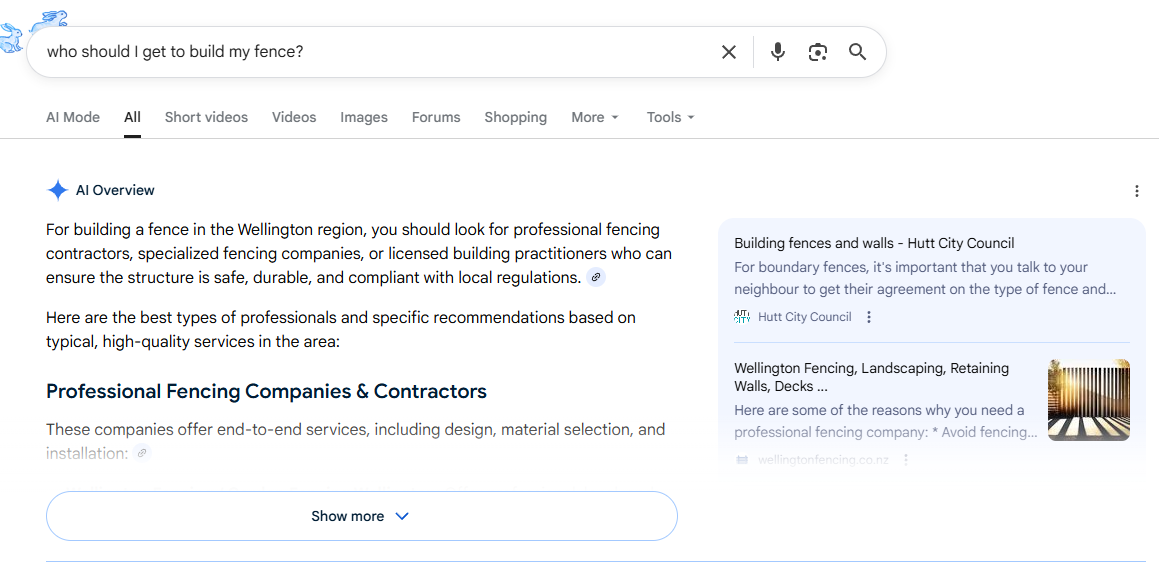
AI tools like ChatGPT, Google’s own AI search, and Perplexity are now answering questions directly — before anyone clicks on a website at all. Instead of returning ten blue links, they return a single answer. The search is over before your site ever enters the picture.
This is not a minor shift, and it has been building for years. SparkToro’s tracking put the US zero-click rate at around 49% back in 2019, roughly 65% by 2022, and around 68% in the first four months of 2026. The exact number shifts depending on the data provider and time period, so treat any single figure as a snapshot rather than a fixed law, but the direction has not reversed once across that entire stretch. Check the “Updated” date at the top of this guide; if it has been a while, the real number today is almost certainly higher again.
Is Google sending less traffic to websites?
Yes. Google itself is one of the main reasons your traffic has dropped.
Google’s AI Overviews — the answer boxes that now appear at the top of many search results — are designed to keep people on Google rather than sending them to your site. When someone searches “how do I find a good plumber in Nelson” and Google answers that question directly on the results page, there is no reason for them to click anywhere.
This is not Google punishing your site. It is Google changing its business model. The result for you is the same either way — fewer people arriving at your website from search.
The businesses that are keeping their enquiry levels steady are not the ones fighting this. They are the ones who have adapted their sites to show up inside these AI answers, rather than waiting to be clicked from a list that fewer people are scrolling through.
Should I be worried about lower traffic numbers?
It depends what the traffic number is actually standing in for.
Traffic was always a proxy metric. Nobody wants visits for their own sake. What matters is calls, bookings, and sales. For years those two numbers moved together closely enough that it didn’t matter, more visits meant more enquiries, so traffic became the number everyone watched.
This reframe only applies to businesses whose website makes money from what happens after the click, a call, a booking, a sale. Most B2B and B2C service businesses fall into this camp. If your site’s revenue comes from advertising or pageviews themselves, like a free news site or a content publisher, this is not good news dressed up. Fewer visits is a straightforward loss, because an ad impression does not care how ready to buy the visitor was.
AI search breaks that traffic-to-enquiry link, and for the businesses above, not always in a bad direction. When someone gets their answer from an AI Overview or a chatbot without clicking through, the searches that disappear from your analytics are disproportionately the early-stage, still-comparing, not-quite-ready ones. The people who do still click through are more often the ones who already know roughly what they want and are checking whether you’re the right fit. On a well-optimised site, fewer visits with a higher proportion of ready buyers can produce the same enquiries, or more.
A simple way to see it: 10,000 visits converting at 1% gives 100 enquiries. 6,000 visits converting at 2% gives 120 enquiries, on 40% less traffic. The visits fell. The result did not.
This only holds up if the site is actually built to win the higher-intent visits it’s now getting, with clear answers, credible signals, and an obvious next step. A site that hasn’t adapted loses the early-stage traffic and doesn’t pick up anything in return, so the drop shows up straight through to enquiries too. That is the difference between a business that’s adjusted to how search works now and one that’s still watching a metric that means less than it used to.
If you’re not sure which one describes your site, that’s exactly what a proper audit is for.
Are people searching in full questions now, not keywords?
Yes, and it changes what “ranking well” actually means.
For years, people typed short, clipped phrases into Google: “plumber Nelson,” “website cost NZ.” Google’s own search box has moved away from that model. AI Mode now handles full sentences and follow-up questions the way you would ask a person, and the ranking systems behind it are built to match content against that kind of query, not a string of keywords.
For your website, this matters directly. A page built around the keyword “plumber Nelson” is competing on outdated terms. A page that clearly answers “why does my toilet keep running after I flush it” in plain language is competing on how people actually search now. Content written around real questions, in the words a customer would use, has a structural advantage that keyword-stuffed pages do not.
Why would a website suddenly disappear from search results?
There are several reasons a site can drop in visibility quickly:
A Google algorithm update. Google updates its ranking system regularly. Sites that were ranking well under the old rules can drop overnight when the rules change. This happens to businesses that were doing things technically right but are now on the wrong side of a shifted benchmark.
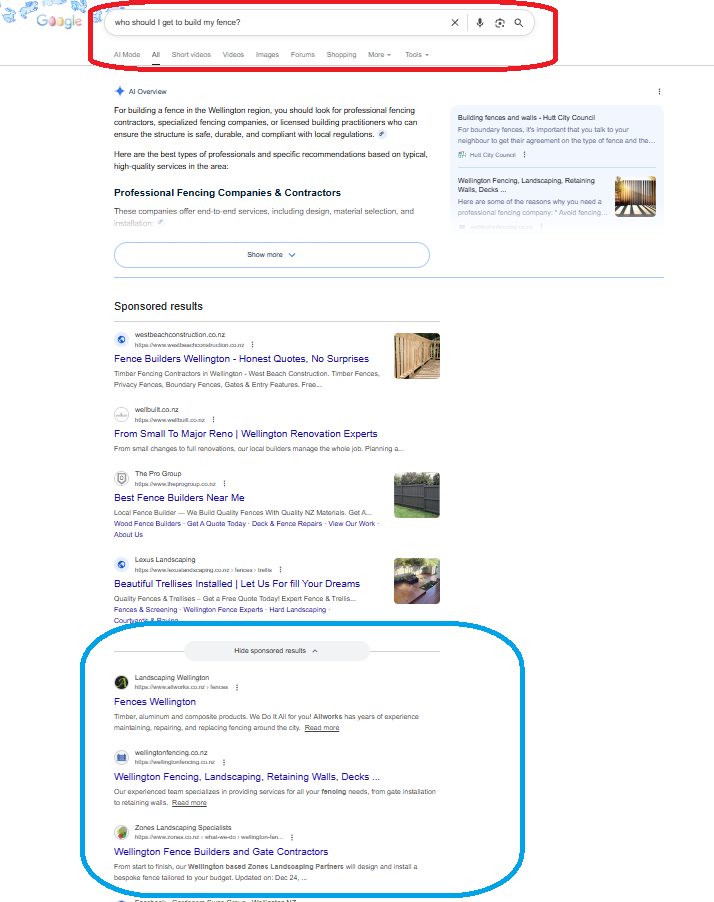
AI Overviews pushed you down the page. Even if your site is still ranking where it was, the results page has changed around you. AI answers, ads, and featured snippets now sit above the traditional results. Being third on Google used to mean being near the top of what people saw. Now it might mean being well below the fold.
Your pages may not be eligible to appear in AI answers. This one is worth checking before assuming anything subtler. To be used as a supporting link in an AI Overview or AI Mode response, a page has to be indexed and allowed to show a snippet in ordinary search. A nosnippet tag or a restrictive max-snippet setting removes you from the whole AI layer without touching your classic rankings — which is exactly the pattern of “still ranking, no traffic” that sends people looking for a content problem that is not there. A host or CDN quietly blocking crawlers does the same thing.
Technical issues. Sometimes the cause is more straightforward — a plugin conflict, a hosting change, a security block, or a crawl error that stops search engines from reading the site properly. These can cause sudden drops that have nothing to do with content or AI.
What did Google actually say about the May 2026 core update?
Not much, and that is normal for a core update.
Google confirmed the update through its Search Status Dashboard and a short LinkedIn post, not a full Search Central blog article. The entire substance of Google’s own statement was:
“Today we released the May 2026 core update. This is a regular update designed to better surface relevant, satisfying content for searchers from all types of sites.”
Google added one line of guidance: “There’s nothing new or special that creators need to do for this update as long as they’ve been making satisfying content meant for people.”
That is the full extent of what Google said directly. The update rolled out over roughly twelve days, from 21 May to 2 June 2026.
What are people reporting so far?
Everything more specific than Google’s statement above comes from independent rank tracking, not from Google, so treat it as informed observation rather than confirmed fact.
Ranking trackers recorded unusually high volatility during the rollout, with around 88% of page-one results changing position. Sites that analysts flagged as coming out ahead tended to share a few traits: clear signals of who is behind the content and why they can be trusted, genuinely updated content rather than just a new date stamp, low ad density, and pages that answer the reader’s question directly near the top instead of making them scroll or click through.
Sites that lost ground tended to be the opposite: thin content rephrasing what already ranks elsewhere, pages heavy with ads, and content with no clear author or business behind it.
None of this is a checklist from Google. It is a pattern several independent trackers converged on after watching the same rollout, worth taking seriously without treating it as gospel.
My traffic was fine after the May update, then dropped later. What happened?
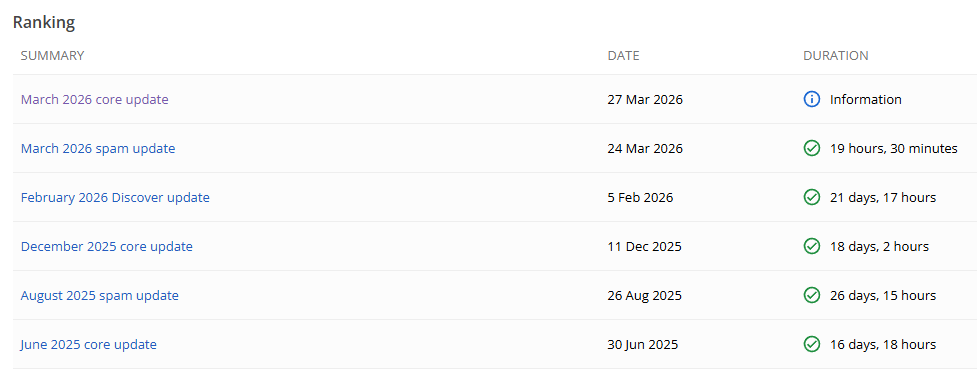
Most people do not spot a traffic drop the day it happens. It usually shows up when someone finally checks analytics weeks later and works backwards. If that is you, and the timing does not line up with the May core update, there is a second update worth checking against: the June 2026 Spam Update, which ran narrowly from 24 to 26 June.
Pull up your analytics and look for a step-change starting in that window, even if you only noticed the overall effect much later. Google’s own statement on it, through the Status Dashboard, was one line: “Releasing June 2026 Spam Update, which is global and for all languages.” No blog post, no scope disclosed.
Spam updates work differently to core updates. Rather than reassessing overall page quality, they target specific manipulative techniques: scaled or AI-generated content produced with little human oversight, scraped pages copied from elsewhere, cloaking, and doorway pages built purely to funnel search traffic. Google’s own spam policies for this update explicitly excluded link spam and site reputation abuse, so if your backlink profile is clean, that was not the trigger.
If your drop traces back to that window, the useful question is not “did Google get worse at ranking me” but “did anything on my site, or anything outsourced on my behalf, lean on shortcuts like bulk AI-generated pages or scraped content.” That is precisely what this update was built to catch.
Why am I not getting traffic to my website from Google?
If your site has always had thin traffic from Google, the most likely reasons are:
- The site was built to look good but not to rank — there is no SEO architecture underneath
- There is no Google Business Profile, or it has not been set up properly — read our guide on what a Google Business Profile actually does and why it matters
- The content on the site does not match what your potential customers are actually searching for
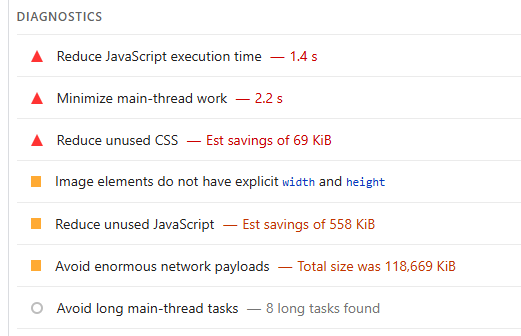
- The site loads slowly, which Google penalises directly — find out why site speed matters more than most people realise
- There are no signals telling Google that your business is credible and worth recommending
None of these are permanent problems. But they do not fix themselves either.
How many searches actually end without a click now?
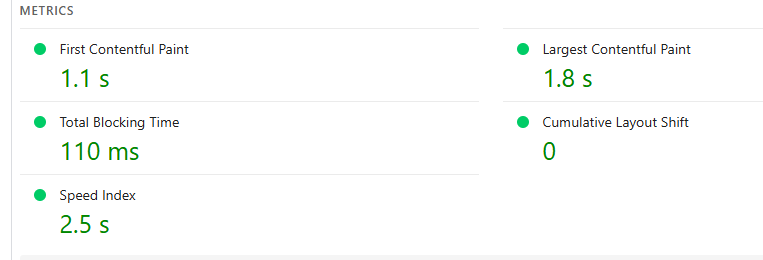
More than most people expect, and the number keeps climbing. SparkToro’s most recent research, based on Similarweb search panel data, puts the US zero-click rate at roughly 68% in early 2026, up from about 60% in 2024. The searcher gets their answer from the results page itself, through an AI Overview, a featured snippet, a knowledge panel, or another Google-generated response, and never visits a site at all.
This is sometimes called a “zero-click search.” It has been growing steadily for years, and queries that trigger an AI Overview show noticeably higher zero-click rates than the average search.
What that actually looks like on a real site
Percentages are easy to nod along to, so here is a concrete one. A small New Zealand site publishing guides on search and AI visibility recorded the following across its ten most-seen queries in a single month:
- 371 impressions — the number of times its pages appeared in Google results
- 1 click
That single click came from someone searching the business name. Across every non-brand query — including 112 impressions for “how to get business in chatgpt results” and 41 for “why has my website traffic dropped” — the click count was zero.
Worth reading that slowly, because there are two entirely different problems hiding inside it, and they need opposite fixes.
The first is the zero-click effect this guide is about. Those are exactly the question-shaped queries that trigger an AI Overview, and an AI Overview answers them on the results page. The impression is real. The visit never happens, because the searcher no longer needs it.
The second is far more ordinary. A page can be indexed, correctly matched to a query, and still sit far enough down the results that nobody ever lays eyes on it. Impressions are counted from page three exactly as readily as from page one.
The metric that separates the two is average position, and it is not shown by default. Add it to your Queries report in Search Console before you conclude anything. Strong impressions at position four with no clicks is a headline-and-snippet problem, or an AI Overview sitting above you. The same impressions at position twenty-five is a plain ranking problem wearing a disguise.
Diagnosing that wrongly is expensive. Rewriting titles will do nothing for a page nobody can reach, and building links will do nothing for a page whose answer has already been given away above it.
For businesses that depend on search traffic, this is the core of the problem. It is not that your site has necessarily got worse. It is that the pipeline feeding it has shrunk.
Are the businesses keeping their enquiry levels doing anything different?
Yes — and the difference is specific.
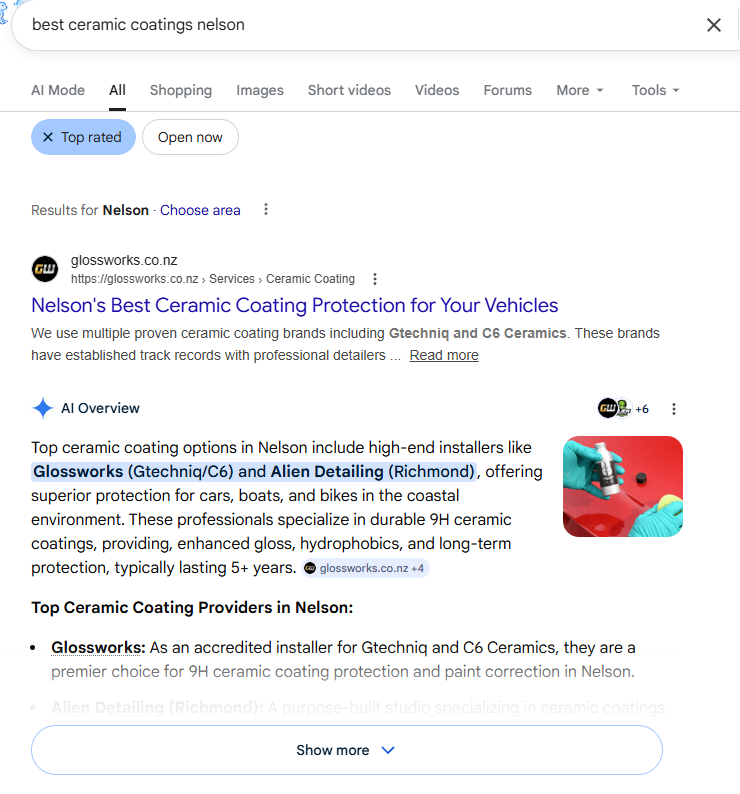
The businesses holding steady have sites that are structured to appear inside AI answers, not just below them. They have content written in plain language that directly answers the questions their customers are asking. They have technical foundations — schema markup, fast load times, clear site structure — that make it easy for AI tools to read, trust, and recommend them.
This is not magic. It is a different approach to how a site is built and maintained, and it is something that can be applied to an existing site or built into a new one from the ground up.
Do FAQ sections still help with Google search?
Differently to before.
Google quietly removed FAQ rich results from Search entirely from 7 May 2026. The expandable question-and-answer snippet that used to appear under some search listings is gone for everyone, not just for you. There was no blog announcement, just a note added to Google’s own developer documentation.
FAQ content still has a job to do. Google has confirmed it still reads FAQ schema to understand what a page covers, and AI tools such as AI Overviews, ChatGPT, and Perplexity pull answers directly from clearly phrased question-and-answer content. The reason to write FAQs now is to be the clean, quotable answer an AI tool lifts into its response, not to win a Google rich snippet that no longer exists.
What should I do if my website traffic has dropped?
Start by understanding whether the drop is AI-related, technical, or both. A proper audit will tell you which — not a five-minute look at Google Analytics, but a structured review of your site’s technical health, content structure, and visibility inside AI tools.
From there, the fixes depend on what the audit finds. Some sites need structural work. Some need new content. Some need both. Some need a rebuild if the foundations are not salvageable.
What most sites do not need is a complete rebrand or a flashier design. Traffic problems are almost always under the surface, not on it.
The honest summary
Website traffic is down across the board for businesses that have not adapted to how search works in 2026. It is a structural shift, not a random dip, and it is not going to reverse on its own.
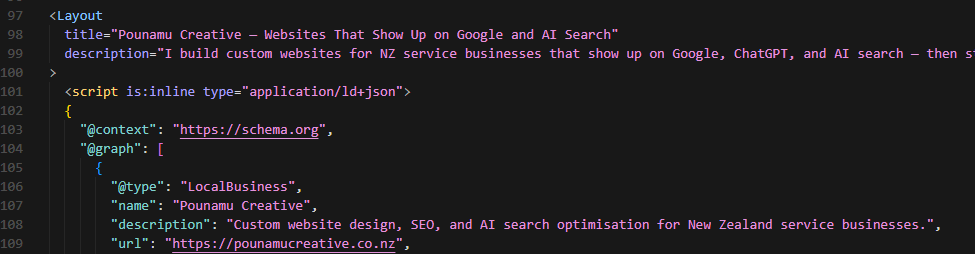
The good news is that the businesses getting this right are not doing anything complicated. They are building sites that answer questions clearly, load quickly, and are structured so that both Google and AI tools know what they offer and who they serve.
That is exactly what a well-built site should do. It just requires someone who is building for 2026, not 2018.
Want to know what AI search actually is and how it works? Read our guide: What is AI search? A plain-English guide for NZ small businesses.
One thing many businesses miss while fixing their search visibility is a simple, free tool from Google that AI tools rely on heavily. Read our guide: What is a Google Business Profile — and does your business need one?
Or if you are ready to talk about your site:
Published by Pounamu Creative, Nelson NZ
Built to be found
Frequently asked questions
- Why do many websites see lower traffic in 2025 and 2026?
- AI answers, zero-click results, and algorithm updates mean fewer clicks for the same impressions. It is often a platform shift, not only something wrong with your site.
- Is my traffic drop always because of AI?
- No. Technical issues, competition, seasonality, and Google updates still matter. Rule those out before blaming AI alone.
- What should I do if organic traffic is falling?
- Check Search Console and analytics, fix technical and speed issues, refresh thin content, and strengthen local and structured signals so you win the clicks that remain.
- Why am I not getting website traffic anymore?
- It is usually AI answers reducing clicks, a recent Google update, or a technical issue blocking your site, rather than one single cause. Check Search Console, note the exact date traffic changed, and compare it against Google's update timeline before assuming the worst.
- I used to get lots of visitors to my website and now I am not getting any. What changed?
- A sudden, sitewide drop usually lines up with a named Google update, a technical fault such as a broken robots.txt or lost Search Console access, or a hosting change. Pin down the exact date it started and work backwards from there.
- What did Google actually say about the May 2026 core update?
- Very little. Google confirmed it through its Search Status Dashboard and a short LinkedIn post, describing it only as a regular update to better surface relevant, satisfying content, with no extra guidance for site owners.
- My traffic was fine after the May update, then dropped later. What happened?
- If the drop traces back to 24 to 26 June 2026, even if you only noticed it weeks afterwards, that points to the June 2026 Spam Update rather than the May core update. It specifically targeted scaled AI-generated content, scraped pages, cloaking, and doorway pages, not general content quality or backlinks.
- Do FAQ sections still help with Google search?
- Yes, but not for a rich snippet, since Google removed FAQ rich results from Search in May 2026. Google still reads FAQ schema to understand your page, and AI tools quote clearly phrased Q&A content directly.