Category: AI and Search
Reading time: approximately 8 minutes
If you have heard people talking about AI search and are not quite sure what it means for your business, this guide is for you. No jargon, no hype. Just a clear explanation of what has changed, why it matters, and what to do with that information.
What does AI search mean?
AI search refers to search tools that use artificial intelligence to answer questions directly, rather than returning a list of websites for you to click through.
When you type a question into Google and it answers it on the results page before you have clicked anything, that is AI search. When you ask ChatGPT for a recommendation and it names a specific business, that is AI search. When you use Perplexity and it summarises an answer with sources, that is AI search.
The common thread is that the answer comes from the AI tool itself, not from you clicking through to a website and reading it there.
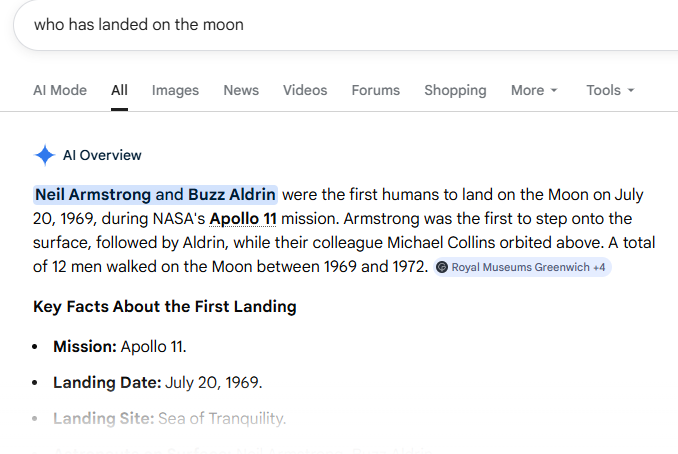
What is the difference between a Google search and an AI search?
Traditional Google search works like a library index. You ask a question, Google returns a list of pages that are likely to contain the answer, and you choose which one to visit. The information lives on the websites. Google just points you toward them.
AI search works differently. The AI has already read vast amounts of content from across the internet. When you ask a question, it synthesises what it knows and gives you a direct answer. It may reference sources, but you do not need to visit those sources to get the information.
For everyday users, AI search often feels faster and more useful. You ask, you get an answer. No clicking, no comparing, no reading through pages that half-answer the question.
For businesses, this creates a real challenge. If people are getting their answers without visiting websites, your site gets fewer visitors even when your business is exactly what they are looking for.
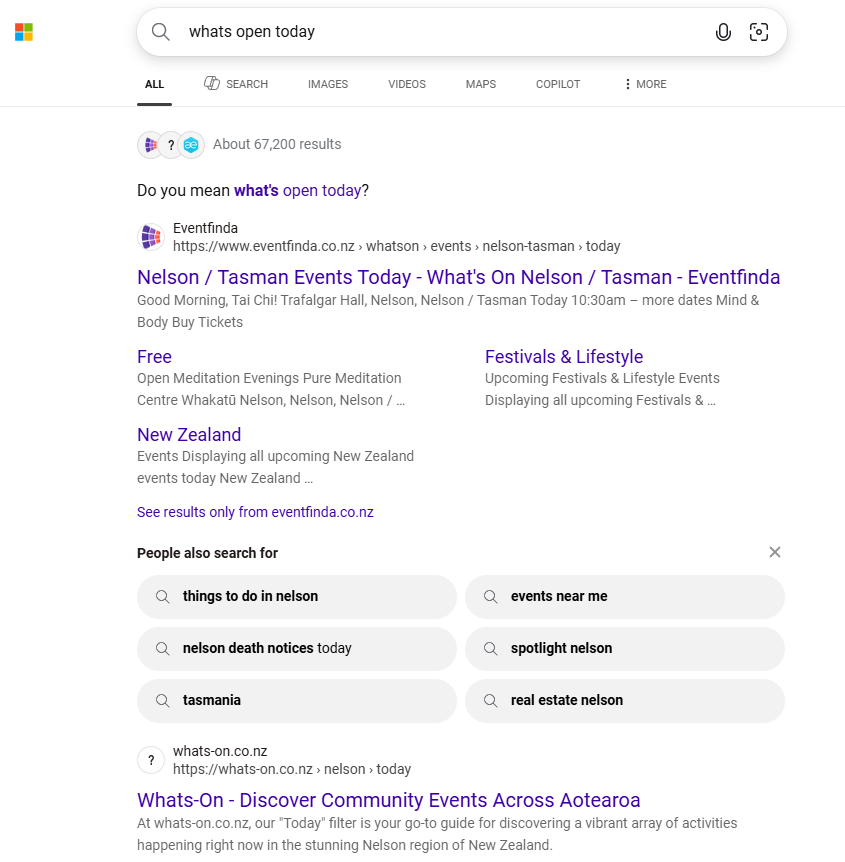
Does Google still show old-style results, or is it all AI now?
Both, and this is worth understanding clearly because it causes a lot of confusion.
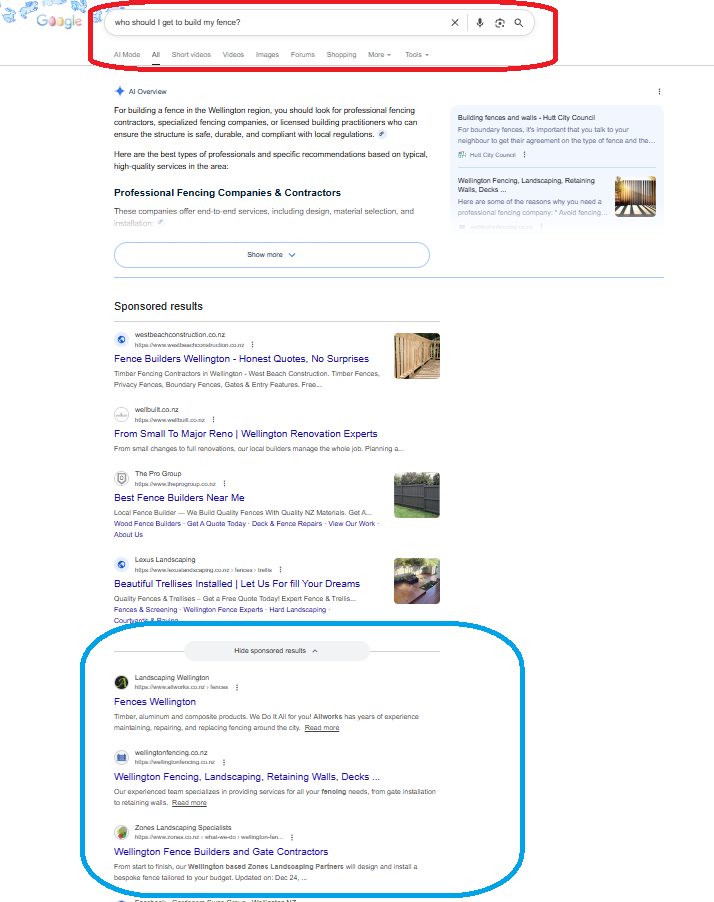
When you search on Google today, you will sometimes see an AI Overview at the top of the page — a generated answer that summarises the topic before any website links appear. Other times you will see the traditional list of blue links with no AI answer in sight. And often you will see a mix of both on the same page.
Whether you get AI results or traditional results depends on the type of question, how well Google’s AI can answer it, and how Google has chosen to handle that particular search at that moment. Factual questions, local recommendations, and how-to queries are more likely to trigger AI Overviews. Niche or highly specific searches may still return traditional results.
What this means practically is that your site may be performing fine in traditional results but completely absent from the AI answers sitting above them. Both matter. A site that shows up in the traditional results but not in the AI Overview is still losing visibility to businesses that appear in both.
All AI search results — whether from Google’s AI Overviews, ChatGPT, or Perplexity — are part of the same shift toward AI-generated answers. The platforms are different, but the underlying principle is the same: the AI is deciding what to recommend, and your site either earns that recommendation or it does not.
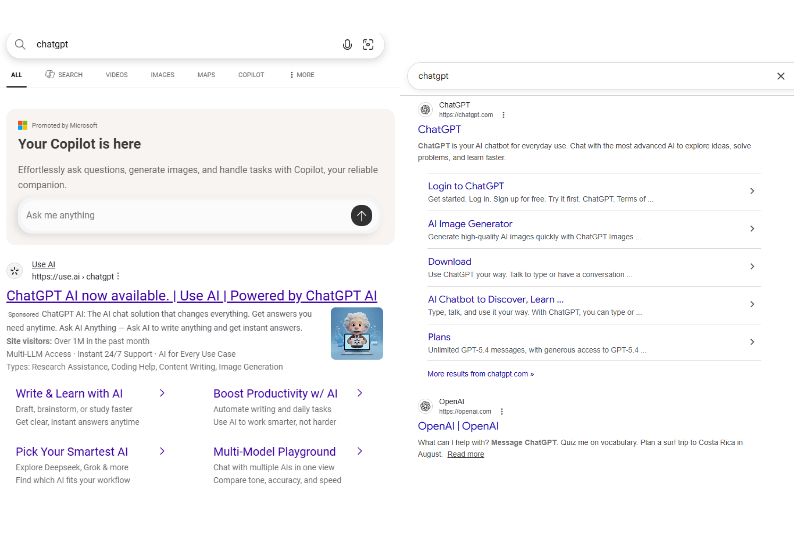
What is the difference between googling something and asking AI?
The experience is similar on the surface but different underneath.
When you Google something, you are searching an index of web pages. The results are ranked by relevance, authority, and hundreds of other signals. You still choose where to click.
When you ask ChatGPT or a similar tool, you are having a conversation with a system that has processed enormous amounts of text and is generating a response based on that. It is not searching in real time in the same way. It is drawing on what it has already learned, then increasingly supplementing that with live web access.
The practical difference for a business owner is this: on Google, you are competing to be clicked. On AI tools, you are competing to be recommended. Those are two different things, and they require slightly different approaches to your website and content.
Can you trust AI search?
This is a fair question, and the honest answer is: mostly, but not always.
AI search tools are genuinely useful and getting better quickly. They are good at summarising information, answering straightforward questions, and making recommendations based on what is publicly available about a business.
Where they can go wrong is with very recent information, niche topics with limited coverage, or situations where the training data contains errors. AI tools can occasionally state something confidently that is out of date or simply wrong.
For a business owner thinking about whether to care about AI search, the trust question actually cuts both ways. Yes, AI can get things wrong. But your potential customers are increasingly using these tools regardless. If your business is not showing up in AI recommendations, you are invisible to that growing segment of people, whether the AI is perfectly accurate or not.
The businesses that are showing up in AI search are the ones that have made it easy for AI tools to find, read, and understand them.
Does it matter if my customers are older?
This is worth thinking about carefully, because the age gap in AI adoption is real but smaller than many business owners assume.
Published survey work consistently shows a wide age gap in AI adoption — usage among adults under 30 running several times higher than among the over-60s. The exact figures vary a lot between surveys, sample and country, so treat any single percentage you see quoted as a snapshot rather than a fact. What has been stable across all of them is the shape: heavy use at the younger end, thinner at the older end, and the gap narrowing every year it is measured.
So if your customers are primarily in their 50s and 60s, AI search is less of an immediate concern for reaching them directly.
However, a few things are worth keeping in mind.
First, the gap on product research specifically is much narrower than the gap on general AI use. Survey after survey finds a meaningful minority of over-50s already using these tools to research a purchase — not a wall, a slope. And it moves in one direction each time it is remeasured.
Second, even if your current customers are older, the people who will become your customers in the next five years are younger. Building for AI search now means you are not playing catch-up later.
Third, first impressions are increasingly formed inside AI-generated summaries, and that reaches further than the people typing the queries. Someone who has never opened ChatGPT still gets recommendations from their daughter who has. Indirect influence does not show up in adoption statistics at all.
The practical takeaway: if your market skews older, AI search is a medium-term priority rather than an immediate one. But it is still a priority, and the groundwork is the same regardless of when you act on it.
Are Google AI search results accurate?
Google’s AI Overviews, the answer boxes that appear at the top of many search results, are generally accurate for well-documented topics. Google has been working to improve them after some early high-profile errors when they first launched.
For local business recommendations, Google has confirmed its AI features can include local business information, and names Google Business Profile as one of the channels feeding it — alongside your website content and review signals. A business with a complete, well-managed Business Profile and a clearly structured site is far more likely to appear accurately in these results than one without.
Worth understanding how the answer gets built, because it explains what actually earns a mention. Google’s AI does not write from memory. Its ranking systems retrieve current pages from the Search index, the AI reads those specific pages, and the response is generated with links to the pages supporting it. So the thing being rewarded is being retrievable — indexed, snippet-eligible, ranking — and then being citable: making clear, verifiable statements a machine can ground a claim in.
Is AI search relevant to my small business in New Zealand?
Yes, and more so than most NZ business owners currently realise.
New Zealanders are adopting AI tools at a rate consistent with the rest of the world. ChatGPT, Google’s AI features, and Perplexity are all used here. When someone in Nelson searches for an electrician, a bookkeeper, or a web designer, a growing number of them are starting that search in an AI tool rather than on Google directly.
The businesses showing up in those results are not large corporations with big marketing budgets. They are businesses of any size that have websites structured to be readable by AI, with content that clearly explains what they do, who they serve, and where they operate.
A small NZ service business can absolutely compete here, and in some ways the local angle is an advantage. AI tools are good at location-specific recommendations. A site that clearly signals “I serve Nelson and the wider Top of the South” is well-placed to appear when someone in that area asks for help.
Will SEO be replaced by AI?
No. But it is changing, and the businesses treating SEO and AI search as the same thing are better positioned than those treating them as separate.
Traditional SEO, the work of making your site rank well on Google, is still valuable and still works. Google is still the dominant search engine by a significant margin. We cover whether SEO is still worth it in 2026 in a dedicated guide.
What AI search adds is a new layer. The same principles that make a site rank well on Google, clear content, technical structure, credibility signals, also tend to make a site more likely to be cited and recommended by AI tools. They are not opposites. They are increasingly the same discipline.
The shift is that the finish line has moved slightly. It is no longer enough to rank. You also need to be the kind of site that AI tools trust enough to recommend directly.
What should I take from this as a business owner?
AI search is not a threat to replace entirely. It is a shift in how people find businesses, and it rewards the same things good websites have always rewarded: clear content, technical quality, and genuine relevance to the people you serve.
If your site was already doing those things well, you are in a better position than most. If it was not, now is a good time to address it, because the gap between sites that show up in AI results and sites that do not will keep widening.
Ready to go deeper? Read our guide: What is GEO and how is it different from SEO?
Not everyone is sure AI search results can be trusted — it is a fair concern. Read our guide: Can you trust AI search results?
Or if you want to talk about where your site stands:
Published by Pounamu Creative, Nelson NZ
Built to be found
Frequently asked questions
- What is AI search in simple terms?
- It is search where an AI generates a direct answer or summary — often on the results page — instead of only showing a list of links for you to open.
- Is AI search replacing Google for everyone?
- No. Google is still dominant, but more queries get answered without a click. Businesses need clear sites and local signals so they still get chosen when people do look deeper.
- Should NZ small businesses care about AI search?
- Yes, as part of the same visibility work. Google's position is that its AI features run on the core Search systems, so clear services, location details and genuine reviews do the job for both — there is no separate AI checklist.