Category: AI and Search
Reading time: approximately 10 minutes
If you have come across the terms GEO or AEO and are not sure what they mean or whether they matter for your business, this guide explains both in plain English.
It also does something most GEO articles do not: it separates what Google has actually published from what the industry has decided to sell. Those two things have drifted a long way apart, and the gap is where most wasted budget lives.
What does GEO mean?
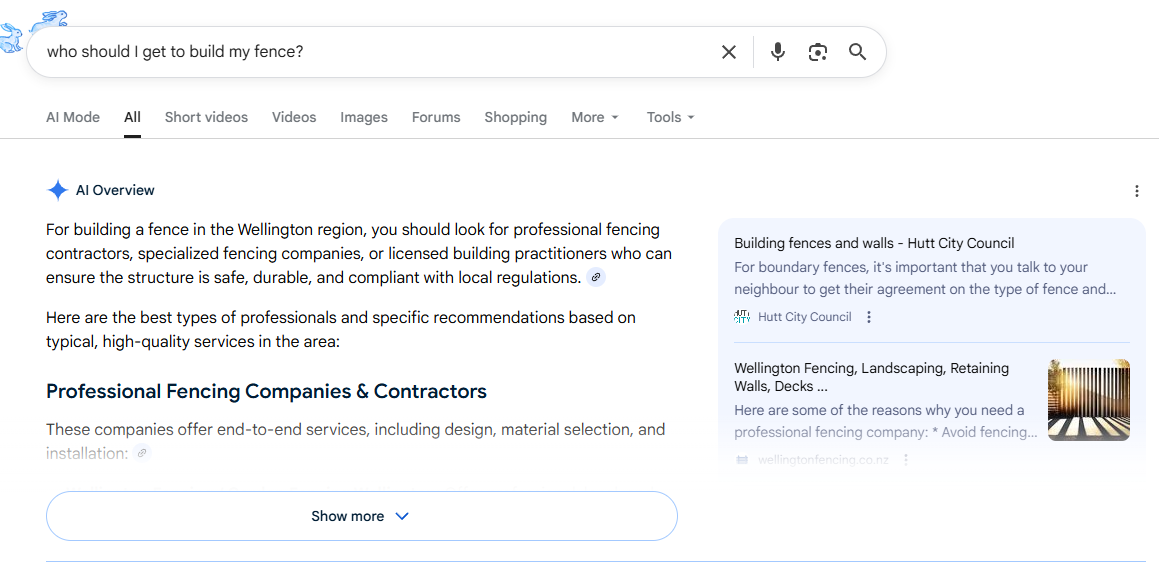
GEO stands for Generative Engine Optimisation.
It refers to the practice of making your website and its content readable and recommendable by AI-powered search tools, such as ChatGPT, Google’s AI Overviews, and Perplexity. Where traditional SEO focuses on ranking in Google’s list of links, GEO focuses on getting your business cited or recommended by tools that generate answers directly.
The “generative” part refers to the fact that these tools produce a response rather than return a list. GEO is the work of making sure your business is part of what they draw on.
What does AEO mean?
AEO stands for Answer Engine Optimisation.
It is closely related and sometimes used interchangeably, though there is a subtle difference. AEO focuses specifically on getting your content to appear as a direct answer to a question — in featured snippets, voice results, or AI-generated responses. GEO is the broader idea of visibility inside generative tools generally.
In practical terms for a small business, they overlap almost entirely. Both come down to being clear, being credible, and being technically readable.
What does Google actually say about GEO?
This is the part worth reading twice, because Google is far blunter about it than most agencies selling GEO services.
Google’s published guidance states that there are no additional requirements to appear in AI Overviews or AI Mode, and that no special optimisations are necessary. The AI features are built on top of the core Search ranking and quality systems, not beside them. There is no separate AI index to get into.
Google addresses the terminology directly too. It acknowledges that “AEO” and “GEO” describe work focused on AI search visibility — and then says that from its perspective, optimising for generative AI search is SEO.
That is not a reason to ignore GEO. It is a reason to be sceptical of anyone selling it as a separate product with its own separate tricks. The delivery is excellent SEO. The genuine skill is knowing which parts of that work matter most to the AI layer, and which of the tactics currently being sold do nothing at all.
We have written a companion guide on exactly that: the GEO tactics Google says do nothing — including one we got wrong ourselves.
How does Google’s AI actually build an answer?
Understanding this explains almost everything else, and it takes one paragraph.
The AI response is not written from training data alone. Google’s core ranking systems retrieve relevant, current pages from the Search index. The AI reads those specific pages. It then generates a response with prominent clickable links to the pages that support it.
So there are two separate things you need to be, and they are not the same:
Retrievable. Indexed, snippet-eligible, and ranking well enough for your page to be pulled into the set the AI reads in the first place.
Citable. Making clear, verifiable statements that an AI can safely ground a claim in. Vague, hedged, brochure-style copy is hard to quote. A page that states a specific thing plainly is easy to quote.
Most sites fail at the first one for boring technical reasons, and never find out.
Are AI Overviews and AI Mode the same thing?
No — and this distinction is almost entirely missing from the way GEO gets discussed.
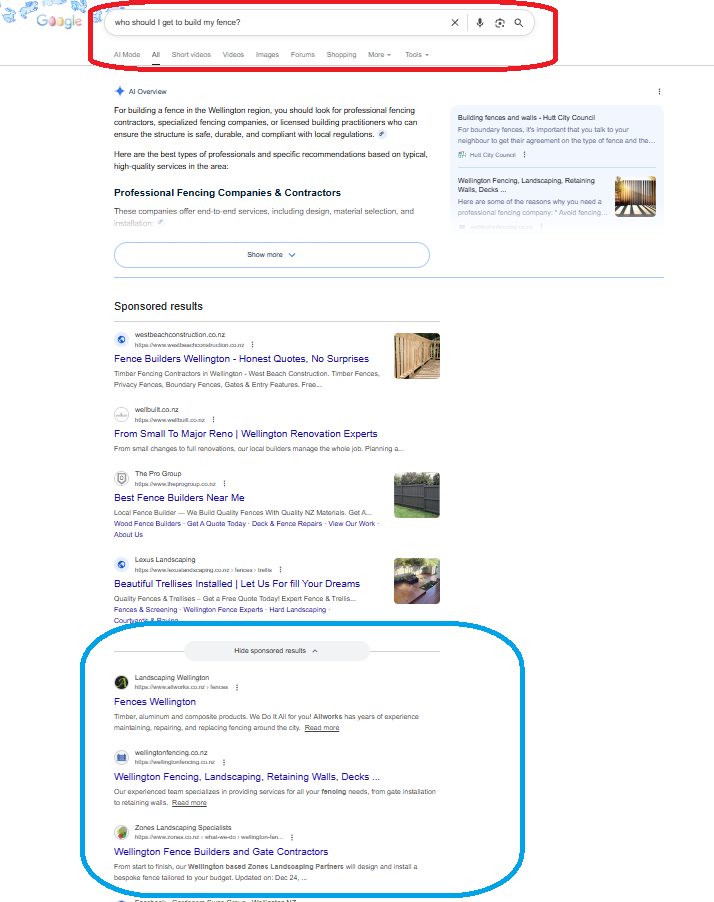
AI Overviews give people the gist of a complicated topic and act as a jumping-off point to links. They only appear when Google’s systems decide they add something beyond classic Search, which means they often do not trigger at all.
AI Mode is a different surface. It handles exploration, reasoning, and complex comparisons — the nuanced questions that used to take somebody four or five separate searches.
Google states the two may use different models and techniques, so the responses and the link sets vary between them. The practical consequence is one most businesses have not registered: appearing in one does not mean appearing in the other. They need to be checked separately.
Neither is niche any more. As of Google’s June 2026 announcement, AI Overviews has over 2.5 billion monthly active users, and AI Mode has passed one billion.
What is query fan-out, and why does it matter for a small business?
This is the most useful thing in Google’s guidance for a business that will never outrank a national competitor on a head term.
Rather than answering one query, both AI Overviews and AI Mode issue multiple related searches across subtopics and build the response from all of them. Google’s own example: “how to fix a lawn that’s full of weeds” fans out into “best herbicides for lawns”, “remove weeds without chemicals”, and “how to prevent weeds in lawn”.
Google states plainly that this lets it display a wider and more diverse set of links than classic search.
That is the opening. You do not have to be the single best page for “web designer Nelson” to appear. You have to be the best answer to one of the specific sub-questions the fan-out generates — and a small business with genuine first-hand knowledge can absolutely be that.
One warning comes attached, straight from Google. Creating separate pages for every query variation, primarily to manipulate rankings or AI responses, violates the scaled content abuse spam policy. Cover a topic properly because your customers need it covered — not one thin page per phrasing. Google’s systems understand relevance without needing an exact query-to-page match.
What is the difference between GEO and SEO?
The honest answer is that on Google, they are far more similar than different.
Traditional SEO rests on four pillars: the authority your site carries, the content on it, the technical structure underneath, and how people behave when they land. GEO uses those same foundations with the emphasis shifted.
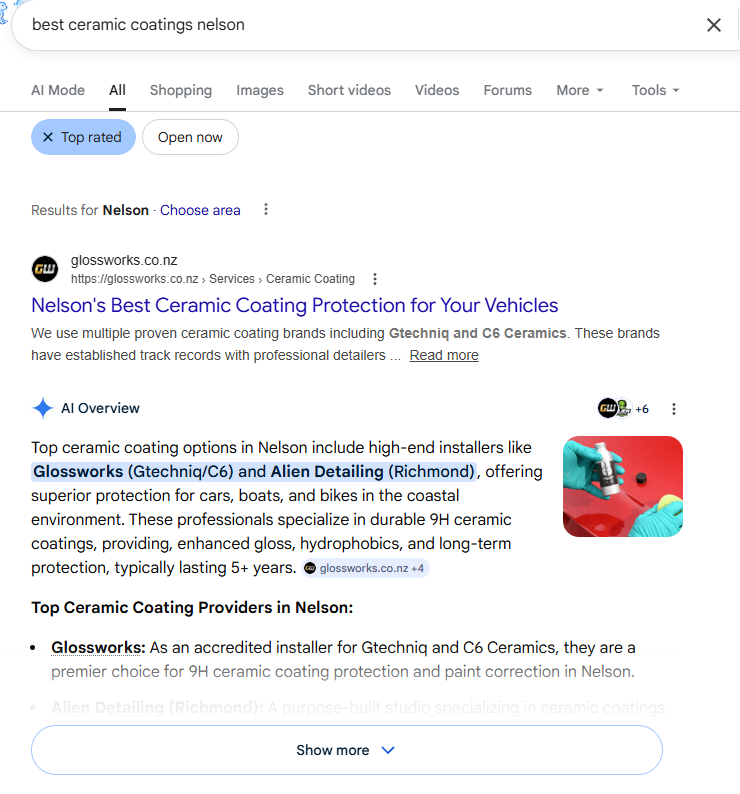
The clearest distinction is what you are competing for. SEO is about being clicked from a list. GEO is about being cited inside an answer. Same groundwork, different finish line.
Where the two genuinely diverge is off Google. ChatGPT, Perplexity, and Bing-grounded systems retrieve differently, so cross-platform work — being present in the sources those tools draw on — remains a real and separate job. Just do not attribute Google AI visibility to tactics Google has explicitly ruled out.
What does Google say actually moves the needle?
Content. Not schema, not markup, not formatting tricks.
Google’s guidance states that unique, valuable content will influence AI search presence more than any of the other suggestions in its own guide. That is a strong claim from a company that spends most of that guide talking about technical fundamentals.
Their definition is specific, and it is worth holding your own pages against it.
A unique point of view. The AI systems look across many sources, so a perspective that stands out is what earns inclusion. A first-hand review beats a summary of existing content. Google’s instruction is unusually direct: do not recycle what the internet has already said, and do not publish what a generative AI model could easily have produced on its own.
Commodity versus non-commodity. Google’s own example pair makes this concrete. “7 Tips for First-Time Homebuyers” is commodity — common knowledge that could have originated from anyone. “Why We Waived the Inspection and Saved Money: A Look Inside the Sewer Line” is non-commodity — an expert or experienced take that goes beyond the ordinary. The second kind is what gets cited.
Structure for humans. Clear paragraphs, sections, and headings. Google frames this as a readability benefit for people, not a machine-parsing requirement.
Their one-line test for any page: is this content that my visitors would find satisfying?
For a Nelson trade or service business, the practical translation is that your real jobs, your real numbers, and your actual opinions are the asset. The generic explainer you could have generated in thirty seconds is not.
What has to be true before you can appear at all?
There is a hard prerequisite that sits underneath everything above, and almost nobody checks it.
To appear as a supporting link in AI Overviews or AI Mode, a page must be indexed and eligible to show in Search with a snippet. Snippet eligibility is not optional. A nosnippet tag, or a max-snippet setting cranked too tight, removes you from the entire AI layer — silently. No error, no warning, and no drop in your classic rankings to tip you off.
The rest of the technical baseline, in Google’s own list:
- Crawlable — allowed in robots.txt and by your CDN or hosting. A security setting that quietly turns away a crawler has the same effect as not existing.
- Findable through internal links — content that nothing links to is content nothing reaches.
- Available as text — important information locked inside an image or video only cannot be read.
- Sound page experience — fast, mobile-first, with the main content clearly distinguishable.
- Structured data that matches visible text — a compliance requirement, not a ranking lever. Markup claiming things the page does not say is a problem.
If you are wondering whether any of this applies to your site, that is exactly what a technical audit is for, and it is worth checking before spending money on content.
What changed in June 2026?
Quite a lot, and most GEO commentary has not caught up with it.
Search Console now reports on AI visibility. Traffic from AI Overviews and AI Mode has always been counted in Search Console, inside the Performance report under the “Web” search type — it just was not separated out. Google has announced AI-specific insights: impression metrics, which of your pages appear in AI responses, and which countries they appear in, with more metrics promised. The rollout began with UK site owners before going global, so timing for New Zealand properties may vary.
This matters more than it sounds. When those reports land, you have first-party AI visibility data from the source, at no tool cost — replacing a category of third-party guesswork currently being sold at a premium.
Preferred Sources now applies inside AI answers. People can nominate sites they want shown more prominently, and that preference now carries into AI Overviews and AI Mode. For a business with loyal customers, asking them to set you as a preferred source is a legitimate, free visibility lever that almost nobody is using yet.
There is now an opt-out toggle. Site owners can exclude their site from Google’s generative AI features entirely. Opted-out sites receive no traffic and no impressions from those surfaces. Google states the toggle is not used as a ranking signal outside the AI features. It is worth confirming nobody has ever switched it on for your site.
More links, and previews. Google has increased inline links within AI responses and added website previews, both intended to encourage click-through.
Is the traffic that survives actually worth having?
A fair question, given AI answers are the reason a lot of sites are seeing fewer clicks.
Google’s own claim is that clicks from results pages carrying an AI Overview are higher quality — people who click through are more likely to spend more time on the site. That matches what you would expect. Someone handed a specific recommendation with reasons has already been part-qualified before they arrive.
That does not make the overall drop in clicks painless, and we have written about it honestly elsewhere: why website traffic has dropped and what it actually means.
What should I do about GEO as a small NZ business?
The most useful thing is to stop treating it as a separate project. It works best built into the foundations of a site rather than bolted on afterwards.
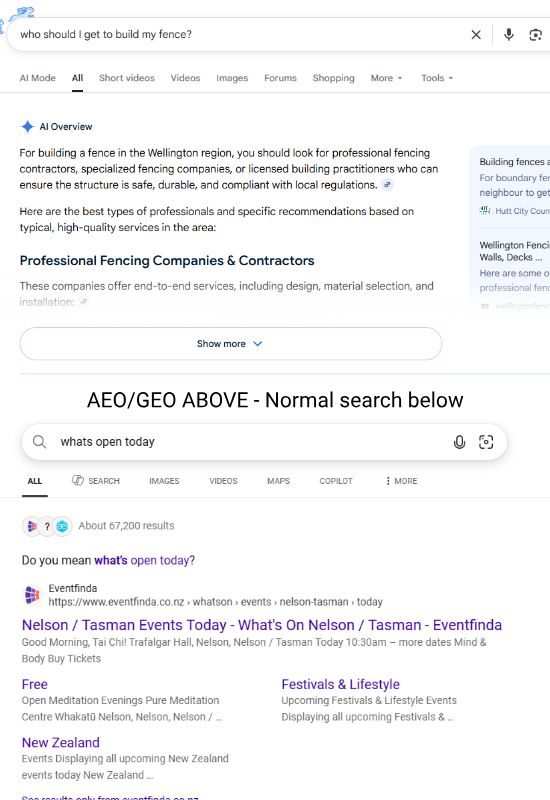
Practically, that means a site that loads quickly, states clearly what you do and where you do it, is indexed and snippet-eligible, and answers the real questions your customers ask — in your words, with your specifics. It means a complete and well-managed Google Business Profile, which Google names as one of the channels feeding local business information into AI responses. It means genuine reviews from real customers, and authentic mentions in the places people actually discuss businesses like yours.
None of that is complicated in isolation. The hard part is doing all of it consistently, and knowing which of the newer “AI visibility” tactics are worth any money at all.
Being sold a GEO package right now? Read this before you sign: The GEO tactics Google says do nothing — including one we got wrong
Want the practical version for ChatGPT specifically? How do I get my business found on ChatGPT and AI search tools?
Or if you want to know what your site currently looks like to AI tools:
Published by Pounamu Creative, Nelson NZ
Built to be found
Frequently asked questions
- What does GEO mean for a small business website?
- It means tuning your content and technical setup so AI-powered search tools can read you, trust you, and mention you in generated answers — not only rank you in a list of links.
- Is GEO the same as SEO?
- On Google, essentially yes. Google states its AI features are built on the core Search ranking systems, there is no separate AI index, and no special optimisations are necessary. The emphasis shifts; the discipline does not.
- What is AEO compared to GEO?
- AEO usually means optimising for direct answers in search; GEO is the broader idea of visibility inside generative tools. In practice the tactics overlap heavily.
- Are AI Overviews and AI Mode the same thing?
- No. They are separate surfaces that may use different models and techniques, so responses and link sets vary between them. Appearing in one does not mean appearing in the other.
- What is query fan-out?
- Rather than answering one query, Google's AI features issue multiple related searches across subtopics and build the response from all of them. Google states this surfaces a wider and more diverse set of links than classic search.
- Can I see how my site performs in AI answers?
- Increasingly, yes. Google announced AI-specific insights for Search Console in June 2026 — impressions, which pages appear in AI responses, and in which countries — rolling out from the UK first.