Category: Website Performance
Reading time: approximately 5 minutes
If you are comparing quotes for a new website and wondering why one is $800 and another is $3,000, the answer usually comes down to this distinction. Template sites and custom-built sites look similar on the surface. Underneath, they are quite different — and those differences matter more than most people realise before they have lived with a site for a year or two.
What is the difference between a template website and a custom website?
A template website starts from a pre-built design that has been created to work for many different types of businesses. You add your logo, your colours, your content, and your photos, and the template does the rest. Platforms like Wix, Squarespace, and WordPress with page builder themes all work this way.
A custom website is built from scratch, specifically for your business. The code is written to do exactly what you need and nothing else. There are no pre-built layouts being overridden, no excess code sitting in the background running processes your site does not use, and no platform restrictions on what can be changed.
The visual difference between the two is often small, particularly at launch. A well-chosen template can look professional and clean. The differences that matter most are not visible at all.
Is a template website good enough for my business?
For some businesses in some situations, yes.
If you are very early stage, testing whether a business idea is viable, or need something online quickly at minimal cost while you validate demand, a template can absolutely serve that purpose. Getting something live and functional is better than having nothing while you wait to afford something better.
If your business is primarily found through word of mouth, social media, or a specific platform, and your website’s main job is just to confirm you are legitimate when someone looks you up, a template will probably do that job fine.
Where templates start to show their limits is when you need the site to actively bring in customers through search. That is where the invisible differences become very visible in your enquiry numbers.
Why does a custom website cost more?
Because it takes considerably more time and skill to build.
A template can be set up in days. A custom build requires planning the structure from scratch, writing code specifically for your site, testing across devices and browsers, and configuring the technical foundations that affect search performance. That work takes weeks, not days, and requires someone who knows what they are doing at a technical level rather than just knowing how to use a drag-and-drop interface.
The other factor is that custom code is lean. It only contains what your site actually needs. Template sites, particularly those built on WordPress with multiple plugins, carry a significant amount of code that runs on every page load whether it is relevant to that page or not. That extra weight is one of the main reasons template sites load slower.
Does a custom website perform better on Google?
Generally yes, and the reasons are specific.
Load speed. Custom-coded sites load faster because they are not carrying the overhead of a template framework and a stack of plugins. Google uses load speed as a ranking factor. A faster site ranks better, all else being equal.
Technical structure. A custom build can be structured precisely for SEO from day one — clean heading hierarchy, proper schema markup, correct canonical tags, and all the technical details that tell search engines and AI tools how to read and rank the site. Template sites can achieve some of this, but often with more friction and limitations.
No plugin ceiling. On WordPress in particular, many of the technical SEO improvements require plugins. Those plugins add weight, sometimes conflict with each other, and often require paid subscriptions to access their full functionality. A custom-coded site has these capabilities built in from the start.
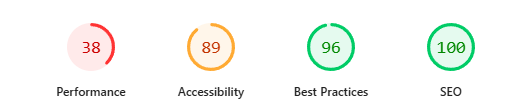
To give you a real-world reference point: across the sites Pounamu Creative has built, every one has scored 90 or above across all four of Google’s independent performance categories, with an average of 97.7 out of 100. That is what is achievable when performance is designed in rather than retrofitted.

What are the real costs of a template website over time?
This is where the comparison shifts significantly.
The upfront cost of a template is lower. But the ongoing cost and the opportunity cost can more than make up for that difference.
Platform subscription fees. Squarespace, Wix, and Shopify all charge monthly fees that continue indefinitely. A $40 per month Squarespace plan costs $480 per year. Over five years that is $2,400, before any other costs.
Plugin costs. WordPress sites that need SEO functionality, performance improvements, security, backups, and contact forms are often running five to ten plugins, several of which require paid subscriptions. These costs accumulate.
Performance limitations. A template site that cannot be properly optimised for search is costing you in missed enquiries, even if that cost is invisible. A site that loads slowly and does not rank well is generating fewer leads than a well-built alternative would.
Rebuild costs. Many businesses end up rebuilding their site within two to three years because the template they chose is no longer serving them. That rebuild cost, added to the original build, often exceeds what a proper custom build would have cost in the first place.
Wix vs custom sites — what is the real difference?
Wix is a capable platform for simple online presences. It is genuinely easy to use, looks reasonably professional, and requires no technical knowledge to set up.
The limitations become relevant when you need more control. Wix restricts access to the underlying code, which means schema markup, advanced technical SEO, and custom integrations are either limited or impossible. Page speed on Wix sites is also notoriously difficult to optimise — the platform generates a significant amount of excess code that cannot easily be removed.
For a small business that needs to rank in search and show up in AI recommendations, those limitations are real constraints rather than minor inconveniences.
WordPress vs custom code — which is better?
WordPress is the most widely used website platform in the world and it is capable of producing excellent sites in the right hands. It is not inherently a bad choice.
The challenge with WordPress for most small NZ service businesses is that a well-performing WordPress site requires ongoing management, plugin maintenance, security updates, and careful configuration that adds up in time and cost. Out of the box, WordPress is a blank slate — getting it to perform at the level a custom-coded site can requires significant work and often paid plugins for each piece of functionality you need.
A custom-coded site bypasses all of that. It does exactly what you need, loads fast from day one, and does not require a plugin for every additional feature. The trade-off is higher upfront build cost and the need for a developer to make changes. For a business that is not constantly updating its own site, that trade-off is usually worth it.
DIY website vs professional web designer — which should I choose?
If your website’s primary job is to generate enquiries from search, a professional build is almost always the better investment.
A DIY site on Wix or Squarespace will get you online. It will not, in most cases, get you found. The technical foundations required for search visibility — speed, structure, schema markup, and AI search optimisation — are either unavailable or extremely difficult to implement properly on DIY platforms.
If your site is primarily a credibility tool for people who already know you, DIY can be a reasonable starting point. If you are relying on the site to bring in new customers who do not know you yet, the limitations will show up quickly in your enquiry numbers.
Ready to understand what a properly built site can do for your specific business? Read our guide: How much does a website cost in New Zealand — and what should you actually get for it?
Performance is where the real difference shows up. Read our guide: Why is my website slow — and what does it actually cost you in customers?
Or if you want to talk through what your current site is and is not doing:
Published by Pounamu Creative, Nelson NZ
Built to be found
Frequently asked questions
- Is a template website good enough for a New Zealand small business?
- Often for early-stage or tight budgets — if performance and SEO limits are acceptable. Growth-stage businesses usually outgrow generic templates within a year or two.
- What is the main downside of template sites like Wix or Squarespace?
- Extra code, design constraints, and sometimes weaker Core Web Vitals versus a lean custom build — which can affect SEO and ad costs.
- When is a custom website worth the extra cost?
- When you need speed, unique workflows, strong local SEO foundations, or you plan to own and evolve the codebase for years.