Category: Getting Started
Reading time: approximately 5 minutes
If you have been shopping around for a website in New Zealand and got back three wildly different quotes, you are not imagining things. A five-page website can genuinely cost anywhere from $500 to $15,000 depending on who you ask and what they are actually building. This guide explains why the range is so wide, what you actually get at each price point, and how to tell whether a quote represents good value or a future headache.
How much does a website cost in New Zealand in 2026?
The honest answer, based on what the market looks like right now:
DIY builders (Wix, Squarespace, Shopify): $30 to $60 per month ongoing, plus your time. Low upfront cost, but you pay forever and you are renting, not owning. Performance and customisation are limited by the platform.
Budget freelancers and offshore teams: $500 to $1,500 upfront. Fast and cheap, but typically template-based with minimal SEO, no schema markup, and little to no post-launch support. You get what you pay for at this end of the market.
NZ-based freelancers: $1,500 to $4,000 for a small business site. Quality varies considerably. Some are excellent, some are not. Ask to see recent work and check the PageSpeed scores on the sites they have built.
Small NZ agencies: $2,500 to $8,000 for a standard brochure site. More structured process, usually includes some SEO foundations and a period of post-launch support.
Mid-tier agencies: $5,000 to $15,000 for a site built to perform. Custom design, proper SEO architecture, content strategy, and ongoing support built in.
Large agencies and enterprise builds: $15,000 to $100,000 and beyond. For complex projects with custom functionality, integrations, eCommerce, or large organisations.
Most NZ service businesses land somewhere in the $2,000 to $8,000 range for a well-built site. Below $2,000, you are almost always looking at a template with limited technical foundations. Above $8,000, you are typically paying for either significant custom functionality or agency overheads.
What is the difference between a $500 website and a $2,000 website?
More than most people realise, and most of the difference is invisible on the surface.
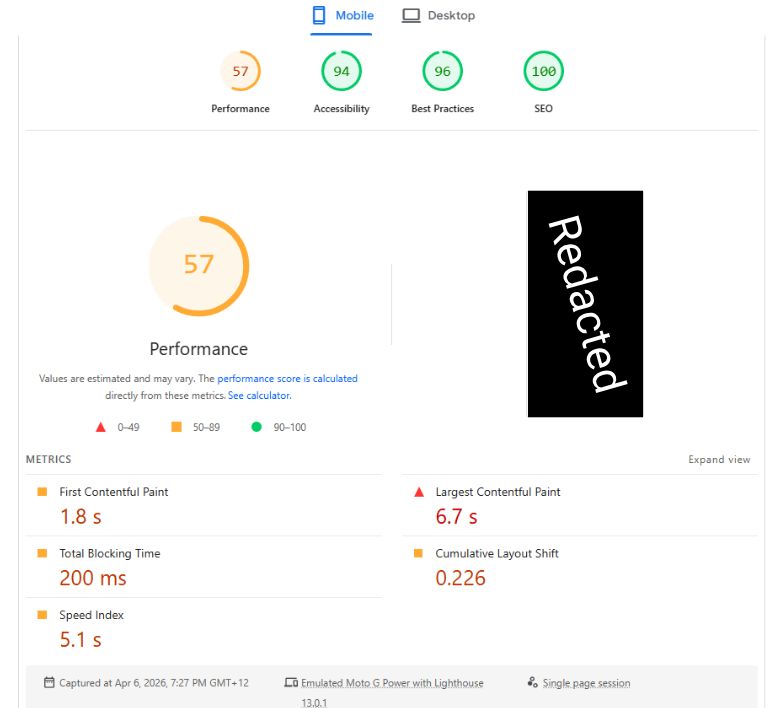
A $500 website is almost certainly built on a template, with minimal configuration. It will probably look presentable enough. But underneath, it is likely slow, missing schema markup, has no meaningful SEO structure, and will not show up well in search results. It is a digital brochure that sits there and hopes people find it.
A $2,000 website built properly is custom coded or at minimum heavily customised, faster from day one, structured for search engines and AI tools to read clearly, and built with the foundations that allow it to actually perform over time.
The visible difference between the two might be subtle. The invisible difference is significant. And the invisible difference is what determines whether the site brings in enquiries or just exists.
Why do some web designers charge so much more than others?
Several reasons, and not all of them mean you are getting more for your money.
Local versus offshore. New Zealand web designers have higher costs of living and operating expenses than designers in India, the Philippines, or Eastern Europe. An offshore team can do the technical work for a fraction of the price, but local knowledge, communication, and understanding of the NZ market come with a local designer.
Agency overheads versus freelancers. A ten-person agency has staff, office space, project managers, and account managers to pay for. That cost is built into every quote. A freelancer or small operator has much lower overheads and can often deliver comparable quality for less.
Templates versus custom. Template-based builds are significantly faster to put together. Custom work takes longer and costs more. The question is whether the custom work delivers a meaningful performance advantage for your specific business.
What is included. Some quotes include copywriting, photography direction, SEO setup, schema markup, Google Business Profile setup, and post-launch monitoring. Others include none of these and charge extra for each. Always ask exactly what is in the quote before comparing numbers.
Why do quotes for similar sites vary so much?
Part of the answer is what is actually included, and this is where it pays to read the fine print carefully.
Many agencies list “basic SEO” as an inclusion. In practice this usually means page titles and meta descriptions have been filled in. It does not mean schema markup, AI search optimisation, Google Business Profile configuration, structured content, or any of the technical foundations that determine whether a site actually performs in search.
Similarly, “post-launch support” often means 30 days of bug fixes, not months of monitoring and adjustment. “Mobile responsive” means the site does not break on a phone, not that it has been built mobile-first with performance as a priority.
This matters because the gap between what is quoted and what you actually need tends to show up about six months after launch, when the site is not performing and you are being quoted for additional services to fix it. By that point, you have already paid for a site that was never going to do the job.
The way Pounamu Creative approaches this is to bake everything in from day one. The starting price of $1,800 includes schema markup, AI search optimisation, Google Business Profile setup, post-launch monitoring, and Cloudflare security — not as add-ons, but as standard. The site is built to perform from the moment it goes live, not patched toward performance after the fact.
This means the headline number sometimes looks higher than a competitor’s “basic” package. But when you add up what is actually included, the comparison looks quite different.
What should be included in a website build?
For a service business investing in a website that will actually perform, a proper build should include at minimum:
Design and development built around your specific business, not a generic template dropped into your branding.
Mobile-first development. Over 65% of NZ web traffic comes from mobile devices. A site that looks great on desktop but awkward on a phone is losing more than half its potential audience.
On-page SEO foundations. Page titles, meta descriptions, heading structure, image optimisation, and internal linking. These should be built in, not treated as an optional extra.
Schema markup. Structured data that tells search engines and AI tools what your business does and where you operate. This is increasingly important for AI search visibility and is still missing from the majority of small business sites.
A Google Business Profile setup or review of your existing one, configured to support local search.
Post-launch monitoring. A site is not finished when it goes live. The first few months of data tell you what is working and what needs adjustment. A builder who hands over the keys and disappears is leaving the most valuable part of the process undone.
Is a cheap website actually more expensive in the long run?
Often, yes.
A site that does not rank, does not load fast, and does not convert visitors into enquiries is not a cheap site. It is a site that cost money and delivered nothing. Many businesses end up paying twice — once for the cheap option, and again for the rebuild.
The more useful question is not “what is the cheapest site I can get?” but “what is the minimum I should spend to get a site that actually does what I need it to do?”
For most NZ service businesses, that number sits somewhere between $1,800 and $3,500 for a properly built site with the right foundations. Below that, you are making compromises that will likely cost you more in the long run.
What about ongoing costs?
A website is not a one-off purchase. There are ongoing costs to factor in:
Hosting: $50 to $150 per month for managed NZ-based hosting with email, SSL, security monitoring, and related essentials included is a reasonable figure for a small business site. Cheap shared hosting at $10 a month tends to produce slow sites and poor support when things go wrong.
Domain name: Around $25 to $50 per year for a .co.nz or .com domain.
Ongoing SEO: If you want to actively maintain and grow your search presence, expect to invest $300 to $500 per month for meaningful ongoing work. This is not a vanity cost. It is the difference between a site that keeps performing and one that slowly becomes invisible. Read our guide on whether SEO is still worth it in 2026.
Content updates: Some hosting arrangements include a period of minor updates. Others charge hourly. Understand what is included before you commit.
Where does Pounamu Creative sit in all of this?
Custom websites from Pounamu Creative start from $1,800. That covers a clean, fast, custom-built site with SEO and AI search optimisation built in from day one, not bolted on later. Hosting and email runs $100 per month and includes everything managed by the same team that built the site.
Every site is custom coded from scratch, which means no plugin stack, no monthly fees to make it perform properly, and no template ceiling on what it can do. Our recent builds have averaged 97.7 out of 100 across Google’s four independent performance categories.
We will always give you a clear number before any work starts, and that number does not change because the build took longer than expected on our end.
Thinking about what kind of site makes sense for your business? Read our guide: What is the difference between a template website and a custom-built one?
Ready to find the right web designer? Read our guide: What should I look for when choosing a web designer in Nelson?
Or if you are ready to get a clear number for your project:
Published by Pounamu Creative, Nelson NZ
Built to be found
Frequently asked questions
- What is a realistic budget for a small business website in New Zealand?
- Many service businesses end up between roughly two thousand and eight thousand dollars for a proper brochure-style site, before major custom features. Very low quotes usually mean templates and thin technical work.
- Why do two quotes for the same size site differ so much?
- Scope differs — SEO, schema, performance, copy, hosting, and support are often partly or fully excluded on cheaper quotes. Always compare line by line, not just the headline number.
- Are ongoing costs normal?
- Yes. Hosting, domain, security, and sometimes SEO or updates are ongoing. Factor them in from the start so the total cost of ownership is clear.