Category: Real Results Reading time: approximately 3 minutes
For a long time, the entire online presence for Kiwi Excavations’ fencing work was a phone number on a page. No enquiry form. Nothing for someone to fill in at eleven at night when they had just decided they needed a quote. No customers could be traced back to the site at all.
The part we did not expect
"It's all working pretty good. We've been getting a bit of feedback, people saying they're AI'ing us and we've been recommended."
— Matt Jordan, Owner, Kiwi Excavations
That is a customer describing, in their own words, being handed Kiwi Excavations’ name by an AI tool — and then telling the business about it afterwards.
It is worth sitting with how specific that is. It is not a ranking report or a visibility score. It is somebody’s customers volunteering, unprompted, where the recommendation came from. That is not something a generic AI summary could invent about a specific business, and it is exactly the kind of first-hand detail Google’s own guidance says AI search is looking for before it trusts and cites a page.
What we actually did
- Rebuilt the website from the ground up, custom coded, no page-speed-killing plugin stack.
- Wrote dedicated content covering the core fencing services, priced with real figures rather than vague ranges.
- Ran a GEO gap analysis, testing real customer-style questions against Gemini and OpenAI to see exactly where the fencing page was being read but not recommended.
- Found the site was appearing in the citation pool for most of those questions, but was inconsistently named, and almost never on OpenAI specifically.
- Kept going from there — still working through the gaps that analysis found and continuing to improve the site’s ability to be cited, rather than treating it as a one-off fix.
That fourth point is the one worth dwelling on, because it is the difference between a guess and a diagnosis. “We are not showing up in AI” and “we are in the citation pool but not being named” are completely different problems with completely different fixes.
The business result, and the honest limit on it
Before the rebuild, nothing could be traced back to the site at all. No form, no enquiry record, no way to connect a single job to the website.
Since then, the clearest evidence is the thing their customers keep saying out loud — that they were recommended by AI. What we cannot give you is a percentage, because the tracking needed to support one is not there.
That is worth being blunt about, because it is the ordinary situation rather than an unusual one. Most small businesses have no reliable way to attribute a job to a channel. Asking “how did you hear about us?” and writing it on a job sheet is not a system, and the answer people give is usually the last thing they remember rather than the thing that actually decided it. Without something better, you are left with exactly what Kiwi Excavations has: the work is coming in, and customers are volunteering where they heard about them.
Putting real attribution in place is the next piece of work on this account. We would rather say that than quote a figure nobody can check.
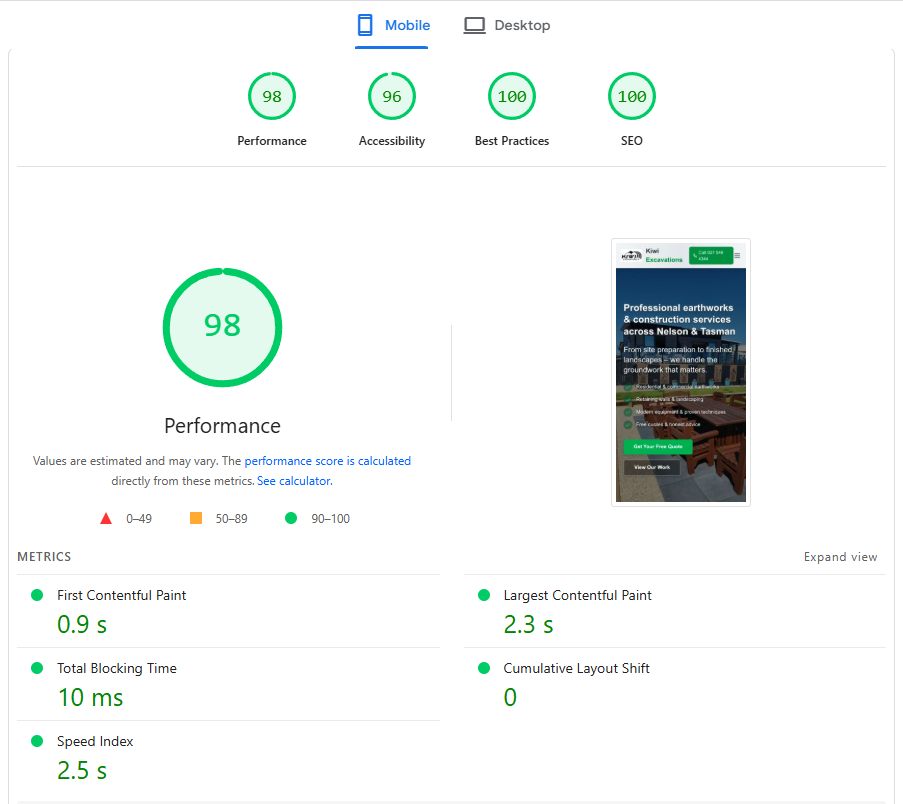
Google’s own PageSpeed Insights tool scored the rebuilt site A, A, A+, and A+ across performance, accessibility, best practices, and SEO, on both desktop and mobile.
They also left this review on Google, in full:
"Aaron's great. Knowledgeable, aware of current trends and is a very likeable person. The website he developed is light years ahead of our previous one."
— Kiwi Excavations, via Google
Why this matters if you’re reading this
A phone number on a page was never going to capture a lead outside business hours, no matter how good the work behind it was.
Being recommended by ChatGPT or Gemini is only half the job. The other half is having somewhere for that enquiry to actually land. Get found without a way to convert it, and the job still goes to whoever picked up the phone first.
Want to know if your site has the same gap? Read our guide: How to get found on ChatGPT
Being sold an AI visibility package? The GEO tactics Google says do nothing
Or if you want a direct conversation about your project:
Published by Pounamu Creative, Nelson NZ Built to be found
Frequently asked questions
- What is a GEO gap analysis?
- Testing real customer-style questions against AI tools like Gemini and OpenAI to see exactly where a page is being read but not recommended — so you can tell the difference between being invisible and being present but unconvincing.
- How do you know AI tools are recommending Kiwi Excavations?
- Their customers told them, unprompted. In the owner's words, people have been saying they were "AI'ing us" and got recommended.
- How much of their work comes through the website now?
- Nobody can say reliably, including us. Before the rebuild nothing could be traced back to the site at all. Since then the clearest evidence is customers telling them, unprompted, that AI recommended them — but the attribution tracking needed to put a percentage on it is not in place yet, and that is the next piece of work.
- Is the work finished?
- No. The gap analysis found the site was in the citation pool for most questions but inconsistently named, and almost never on OpenAI specifically. We are still working through those gaps rather than treating it as a one-off fix.