Category: AI and Search
Reading time: approximately 7 minutes
Scepticism about AI search is reasonable. These tools are new, they make confident-sounding claims, and there have been enough high-profile errors to give people pause. If you are wondering whether to trust what AI tools tell you, or whether it matters that AI tools are recommending businesses to your potential customers, this guide gives you a straight answer on both.
Can you trust AI search results?
Mostly, with appropriate caution in specific areas.
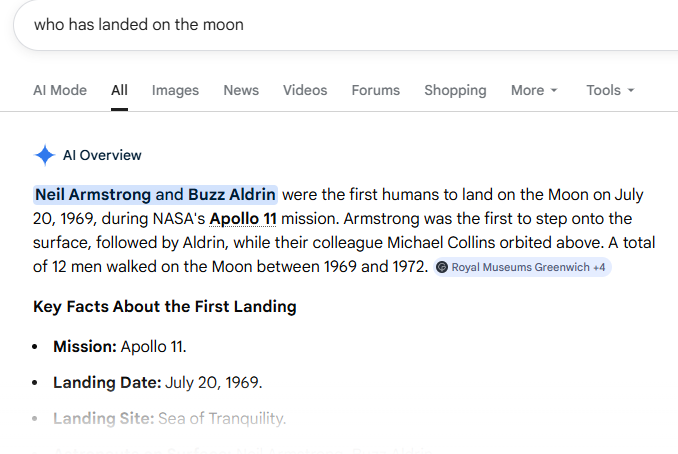
AI search tools — ChatGPT, Perplexity, Google’s AI Overviews — are genuinely useful for a wide range of queries. They are particularly good at synthesising information from multiple sources, answering explanatory questions, and making recommendations based on what is publicly known about businesses and services.
Where they can go wrong is with very recent events they have not been trained on, highly specific factual claims where accuracy matters significantly, and niche topics where the available training data is thin or inconsistent. For medical, legal, and financial questions in particular, AI tools regularly recommend verifying with a qualified professional — and that recommendation is sound.
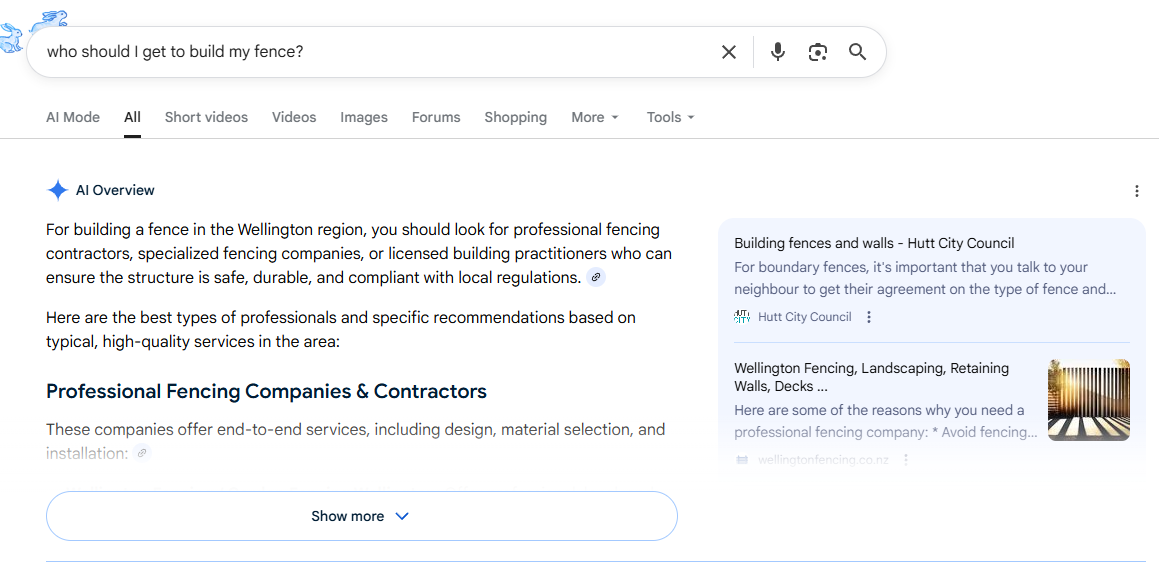
For everyday business recommendations — finding a tradie, a bookkeeper, a web designer — AI tools are generally reliable, drawing from review platforms, business directories, and structured data on websites to build their responses.
How to verify AI information
The most practical approach is to cross-check anything specific and consequential.
If an AI tool tells you a business is open until 6pm, check their website or Google Business Profile before turning up. If it recommends a specific service provider, look at their reviews independently. If it cites a statistic, trace it back to the original source.
Most AI tools will either cite their sources or acknowledge uncertainty when asked. Perplexity is particularly transparent about sources. ChatGPT, when it has web access, can often point to where it found information. Asking follow-up questions — “where did you get that?” or “how confident are you about that?” — is a reasonable habit.
The broader point is that AI search and traditional search both warrant a degree of healthy scepticism. The skill is not whether to trust AI search, but how to use it well.
What is the difference between AI search and traditional search?
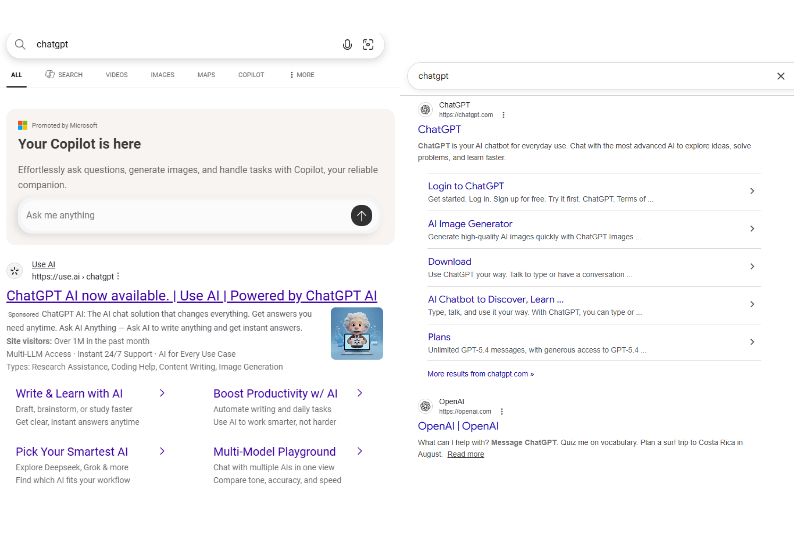
Traditional search returns a list of sources and lets you evaluate them. AI search synthesises those sources and gives you a conclusion. Both approaches have value; they just serve different purposes.
When you need to browse options and compare sources directly, traditional search is better. When you need a quick, synthesised answer, AI search is often faster. Most people are increasingly using both, switching between them depending on what they need.
For businesses, the practical implication is that you need to perform well in both environments. A site that ranks on Google but is not being cited by AI tools is leaving an increasingly significant share of potential customers unreached.
Does AI have bias in search results?
Yes, in ways that are worth understanding.
AI tools learn from the data they are trained on, which reflects the internet as it exists — including its gaps, imbalances, and inconsistencies. Businesses that are well-represented online, with consistent information across multiple platforms, reviews on reputable sites, and clearly structured websites, are more likely to appear in AI recommendations than businesses with thin or inconsistent online footprints.
This is not deliberate bias in the way the term is sometimes used. It is a structural consequence of how AI tools gather and weigh information. A business that exists primarily through word of mouth, with minimal online presence, is simply harder for AI to find, verify, and confidently recommend.
The practical implication for small businesses is that building a consistent, credible online presence is not just good for Google rankings — it reduces the risk of being overlooked by AI tools through no fault of your own.
Is ChatGPT reliable for business recommendations?
Generally yes, for local service businesses with a reasonable online presence.
ChatGPT draws on training data, web search where enabled, and structured sources to make recommendations. For a business with a complete Google Business Profile, genuine reviews, a well-structured website, and a consistent presence across directories, ChatGPT is likely to find that business and recommend it appropriately.
For a business with minimal online presence, ChatGPT may not be aware of it at all, or may have outdated or incomplete information. This is less a reliability problem with ChatGPT and more a visibility problem for the business.
One honest caveat: AI recommendations are not perfectly consistent. The same query asked multiple times may produce different results. This is a known characteristic of how these tools work rather than a fundamental flaw — they are probabilistic systems, not databases. For any individual recommendation, this variability is manageable. Over time, and across many searches by many potential customers, consistent visibility is what matters.
Why does AI give different answers to the same question?
Unlike a database that stores fixed answers, AI tools generate responses by calculating the most likely useful answer based on everything they have been trained on. Think of it less like looking up a fact in an encyclopaedia and more like asking a knowledgeable person who draws on everything they know to give you their best answer in that moment. The answer is informed and usually helpful, but it is not guaranteed to be identical every time.
For businesses, this means a single snapshot of what an AI tool says about you is not the full picture. What matters is how consistently and accurately you appear across many searches, many users, and many AI tools over time. That consistency is built through a strong, well-structured online presence — not through gaming any single platform.
Do AI tools recommend the same businesses that Google ranks?
Not necessarily — and the gap is wider than most people expect.
In September 2026 we asked ChatGPT for the best web designer in Nelson. Separately, we looked at which Nelson studios surface in an ordinary web search for the same thing. Then we compared the two lists.
ChatGPT named five studios. The search surfaced seven. Across the eight distinct businesses appearing on either list, only two were on both. Three of the five that ChatGPT recommended did not show up in the search results we saw at all.
One detail in that answer matters more than the names. Every business ChatGPT named came with a star rating and a review count attached, and it cited a regional directory alongside the studios’ own websites. It was not reading search rankings. It was reading reputation signals held on other people’s platforms.
The practical implication is uncomfortable but useful: ranking well and being recommended are not the same outcome. If your visibility plan is entirely about your Google position, you have covered one of two surfaces and have no evidence about the other. The work that feeds the second one — a complete Google Business Profile, genuine reviews in real numbers, accurate listings on the directories your industry actually uses — is not the same work as ranking a page.
Method and limits: one query, one tool, one account, one day, compared against one set of search results. Search results and AI answers both vary by person, location and time, so treat this as an illustration of the gap rather than a measurement of it. We have not named the studios — the point is the overlap, not who was on which list.
Why does it matter if AI recommends my business?
Because an increasing number of your potential customers are starting their search there.
There is also a quality argument, and this one comes from Google directly rather than from industry speculation. Google states that clicks from search results pages carrying an AI Overview are higher quality — people who click through are more likely to spend more time on the site.
That matches what you would expect. Someone handed a specific recommendation with reasons is not browsing a list and weighing options. They have already been part-qualified before they arrive, which is a different kind of visitor to a cold click from position seven.
For a small service business, being consistently recommended by AI tools is the equivalent of having a very good word-of-mouth reputation in a digital context. The business that shows up in these recommendations, reliably and accurately, is in a meaningfully better position than the one that does not.
How to get your business recommended by AI tools
The same things that make a site visible to Google make it visible to AI tools, with a few specific additions:
Clear, well-structured website content that directly answers the questions your customers ask. Pages that are indexed and eligible to show a snippet, since that is a hard prerequisite for appearing in a Google AI answer at all. A complete and active Google Business Profile, which Google names as one of the sources its AI features draw on for local business information. Consistent business information across directories and platforms. Genuine reviews from real customers.
Worth noting what is not on that list. Google has stated that structured data is not required for its generative AI features and that there is no AI-specific schema. We still add schema to every build, because it earns rich results in ordinary search — but anyone pitching it to you as an AI ranking lever is selling something Google has ruled out.
None of these are complicated in isolation. The challenge is doing them all consistently, which is why most small businesses find it easier to work with someone who builds this in from the start rather than retrofitting it later.
Want to know specifically what it takes to get found on ChatGPT and other AI tools? Read our guide: How do I get my business found on ChatGPT and AI search tools?
Not sure what AI search actually is or how it works? Read our guide: What is AI search? A plain-English guide for NZ small businesses.
Or if you want to understand where your current site stands with AI tools:
Published by Pounamu Creative, Nelson NZ
Built to be found
Frequently asked questions
- Can you trust AI search results for business decisions?
- For general research and shortlists they are often useful, but verify anything high-stakes — pricing, legal matters, and medical advice need human confirmation.
- Why do AI tools sometimes get business facts wrong?
- They predict plausible text from training data and may lack recent or niche detail. Cross-check names, hours, and contact details on official sites.
- Should my business care if AI recommends competitors?
- Yes. People use AI for recommendations; consistent listings, reviews, and a clear website improve the chance you are named accurately.
- Do AI tools recommend the same businesses that rank on Google?
- Not reliably. In September 2026 we compared the studios ChatGPT named for one Nelson query against those surfacing in an ordinary web search, and only two of the eight businesses involved appeared on both lists. Ranking well and being recommended are different outcomes, fed by different work.